Design Notes
Oval Marble Dining Table for 8 — How to Choose the Right Size
An oval marble dining table for eight can start at around 220 × 110–120 cm (87 × 43–47 in). At that size, try placing three chairs along each side and one at either end. Then test the arrangement with the chairs you plan to use. The shape of the oval, the width of the chairs and the position of the bases all affect how comfortably eight people can sit.
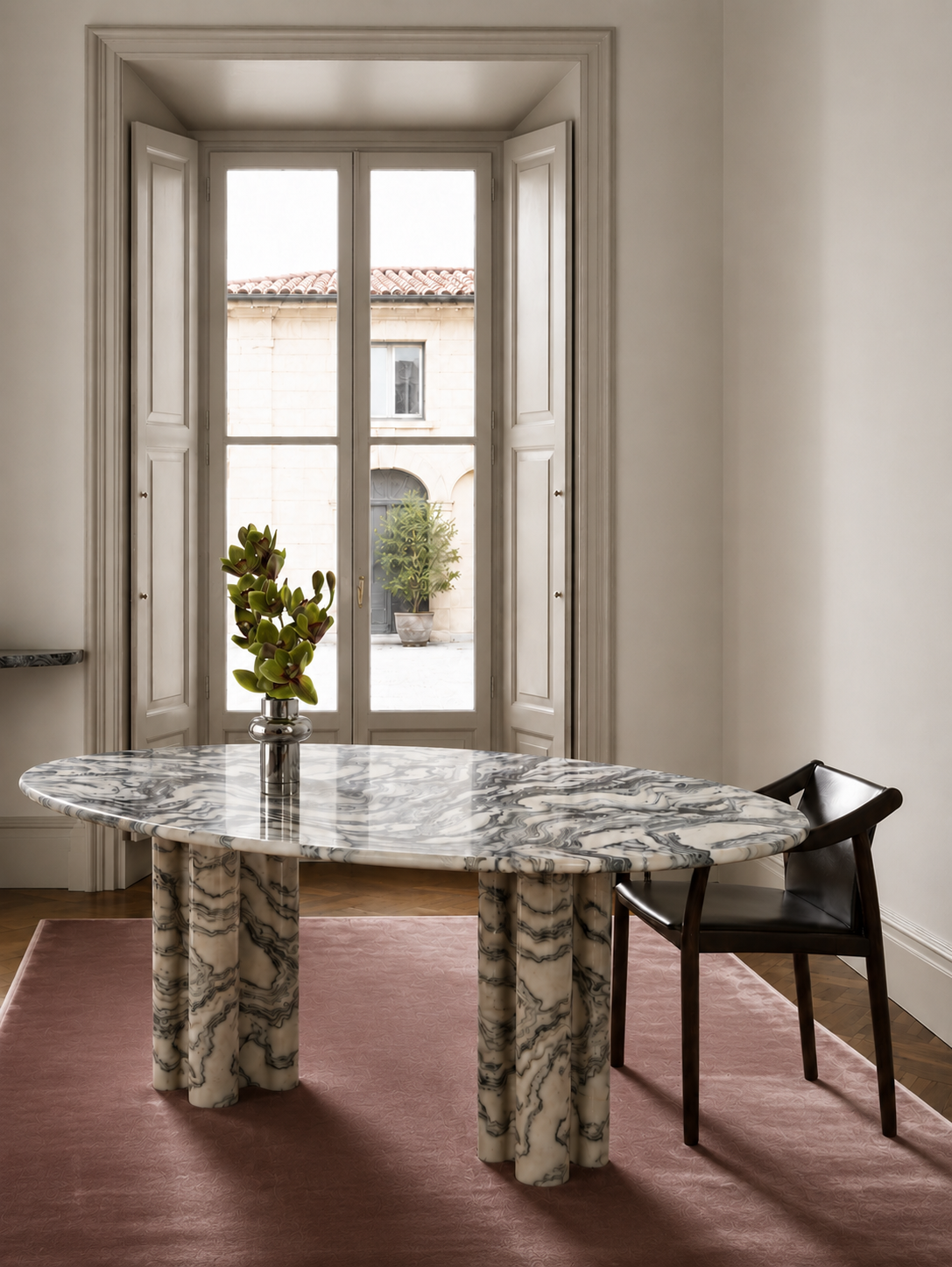
Sasso oval dining table, design rendering by Studio IB Milano.
01
Start with the chairs and the floor plan
Draw the tabletop and all eight chairs to scale, or mark the outline on the floor with painter’s tape. Test the end seats first. An oval narrows at each end, so two tables with the same overall length and width can offer quite different amounts of room around those seats. If you’re using upholstered chairs with arms, check their widest point and whether the armrests fit under the top.
Allow around 90 cm (35 in) from the edge of the table to the nearest wall or piece of furniture as a starting point. For a 220 × 110–120 cm table, that translates to a clear area of roughly 400 × 290–300 cm (157 × 114–118 in). Give the busier side more space if it connects to the kitchen, a doorway or a sideboard. To test that route, leave a chair pulled out as it would be during dinner and walk past it.
02
Design the base around the seats
A sculptural base changes the experience of sitting at the table as much as it changes the view across the room. With a central pedestal, check the distance from the edge of the top to the pedestal at the point where your knees will be. With two bases, draw their outlines on the same plan as the chairs. A base can look perfectly balanced from the doorway and still meet a guest’s knees when they pull in.
For a bespoke table, we develop the profile of the top and the position of the supports together. On an oval, even a small change in the curve can give the end seats more room and change how the table reads from the entrance.
03
Choose the marble and finish in the room’s light
Look at the whole slab before deciding where the oval will be cut. A strong vein running along the length can draw the eye from one end of the room to the other. A diagonal vein changes the composition, especially if the table is first seen from one end.
Compare honed and polished samples under the light the table will actually receive. A honed finish gives a softer reflection. A polished finish catches more light and can give the veining greater visual depth. Look at the sample in daylight and again under the pendant or evening lighting. On a surface this large, the difference is part of how the room feels.
04
Ombra Villa and the sculptural oval
In the dining room at Ombra Villa in Piedmont, Studio IB Milano designed an oval Calacatta marble table with fluted sculptural bases. The movement of the stone sits against dark walnut seating, a muted rose rug and herringbone parquet. The curved top and the repeated vertical lines of the bases give the table a different presence when seen across the room and when approached from the end.
05
Commissioning an oval marble dining table
For a table designed around your room, start with a floor plan, the dimensions of your chairs and the number of people you seat most often. A photograph from the doorway helps us understand how you first see the table. From our studio in Milan, we develop the proportions, stone and finish with Italian artisans.
Planning a dining room for eight? Send us your floor plan and chair dimensions so we can study the right proportions for your space.